

Published 24 October 2026 · By JonsTech
How Often Should a SaaS Company Post on Social Media?
There is no universal posting quota for SaaS. Start with a cadence your team can maintain, plan useful variety, and review provider-reported results over time.
A SaaS company should post as often as it can share something useful without turning publishing into a chore. If you are unsure where to begin, try three planned posts a week on the channels that suit your audience, then adjust after you have enough consistent activity to review. Treat that as an illustrative starting point, not a rule or a performance benchmark. Your available time, material and audience matter more than a generic frequency target.
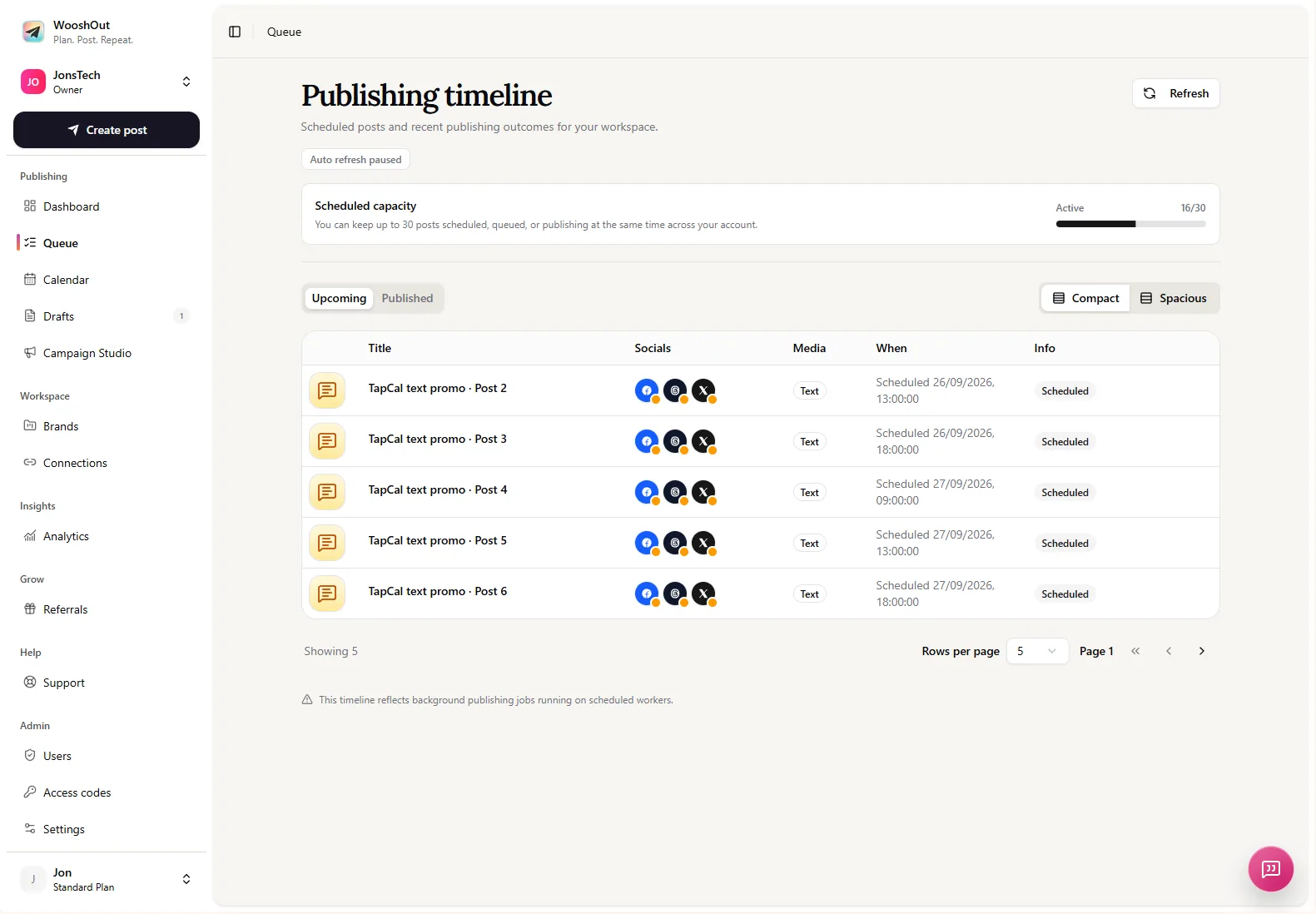
The accompanying Queue screenshot shows one way to make that rhythm visible: upcoming posts are listed with their destinations, dates, times and statuses. A schedule helps you see what is planned; it does not tell you how often your audience wants to hear from you.
Choose a cadence you can actually sustain
Start with your real capacity. How many hours can you set aside for writing, making or selecting visuals, adapting posts for different platforms, and replying to people? What useful material do you already have: product demonstrations, answers to customer questions, release notes, lessons from building the product, or feedback you can share with permission?
If one post takes most of an afternoon, planning daily updates may not be realistic. If you can turn a demo or a well-developed product question into several distinct posts, a few updates a week may be manageable. The aim is not to fill every slot in a calendar. It is to build a repeatable routine without sacrificing usefulness or accuracy.
A simple way to choose a starting pace is to work backwards from the time you have. Set aside a weekly block for planning and drafting, leave time to review platform-specific copy, and keep some capacity for timely posts or replies. If the plan repeatedly slips, reduce the number of posts. A smaller schedule that actually happens gives you more to learn from than an ambitious plan you rarely complete.
Plan a mix, not three versions of the same announcement
A steady cadence is easier to maintain when each post has a clear job. For a SaaS product, a weekly mix might include a practical tip, a product example, and a response to a common question. A launch or feature release can add timely material, but you do not need a new announcement every week to have something worth saying.
For example, a small app company might show how a feature solves a specific task on Monday, share a short demonstration on Wednesday, and answer a recurring customer question on Friday. That is a planning pattern, not a formula. Change it when you have a release, a useful customer insight, or no good reason to publish. A quiet day is preferable to posting filler just to meet a number.
You can reuse the core idea across channels without copying it word for word. A short video could become a TikTok or Reel, while a concise text explanation may suit Threads or X. Check each destination’s format and audience, and adapt the caption and settings where needed. WooshOut’s composer supports shared copy with per-platform adjustments for selected destinations; its feature overview describes the available publishing and scheduling tools.
When you are short on fresh ideas, look for a useful point inside existing material rather than inventing news. A product demo can show one task, a customer question can become a clear explanation, and a release note can be divided into separate posts about the problem, the change and how to use it. Each post should still make sense on its own.
An illustrative starting week
Here is a hypothetical schedule for a small SaaS team starting with three posts a week. The times and frequency are examples for organising work, not recommendations about when an audience is most active or predictions of results. Choose the channels that fit your product and adapt each post to its destination.
Monday: Share one practical lesson related to the problem your product helps solve. Make the post useful even to someone who has not signed up.
Wednesday: Show a product workflow or feature in context. Use a short video, a screenshot or a concise text explanation, depending on the channel.
Friday: Answer a common question, explain a small product decision, or invite a specific discussion. Avoid a broad engagement prompt that gives readers no reason to respond.
Before scheduling, check that the three posts do different jobs. If Monday and Wednesday both amount to “here is our product”, revise one to teach, demonstrate or explain something more specific. If Friday’s post has no useful point yet, leave the slot open. You can make a draft and return to it rather than publishing unfinished work.
For more examples of what to publish between announcements, see what to post when your SaaS has no news. The point is not to make every day a publishing day, but to build a set of useful themes you can return to.
Use a calendar to organise the routine
Once you have a workable plan, put it somewhere you can inspect before posts go live. A social media content calendar can reveal an overloaded week, repeated themes, empty stretches and posts that still need review. WooshOut’s Calendar gives a month view of scheduled posts and publishing outcomes. Its Queue is a closer view of upcoming work, including post destinations and statuses.
For a small team, a useful weekly check might be: Are the right accounts selected? Does each post fit its destination? Are the captions and media ready? Is the schedule in the intended timezone? If a post is not ready, keep it as a draft or move it rather than letting the calendar create false confidence.
With WooshOut, you can prepare a post once, choose compatible connected accounts, edit copy or settings for individual networks, then save a draft, publish now or schedule it. Publishing outcomes are tracked separately by destination. So if one network has a problem, check the Queue or post details for that result rather than assuming every selected account had the same outcome. Scheduling organises the work; it does not guarantee every post will publish successfully.
Review results without treating them as a verdict
After you have followed a cadence consistently for a while, look at what people did with the posts and whether the routine is sustainable. Depending on the network and available data, useful indicators might include views or reach, interactions, comments, shares, and audience changes. Compare similar posts on the same platform where possible. A video view and a text-post interaction are not interchangeable measures.
WooshOut’s Analytics page brings together metrics reported by connected social networks, with individual network views and top content where data is available. These figures are cached rather than real-time: current product information says eligible connections generally refresh at most once per UTC day for networks other than X, and at most once every seven days for X. The available metrics differ by provider, and connection or data availability can affect what appears. Check the sync status and the reporting context before drawing conclusions from a recent post.
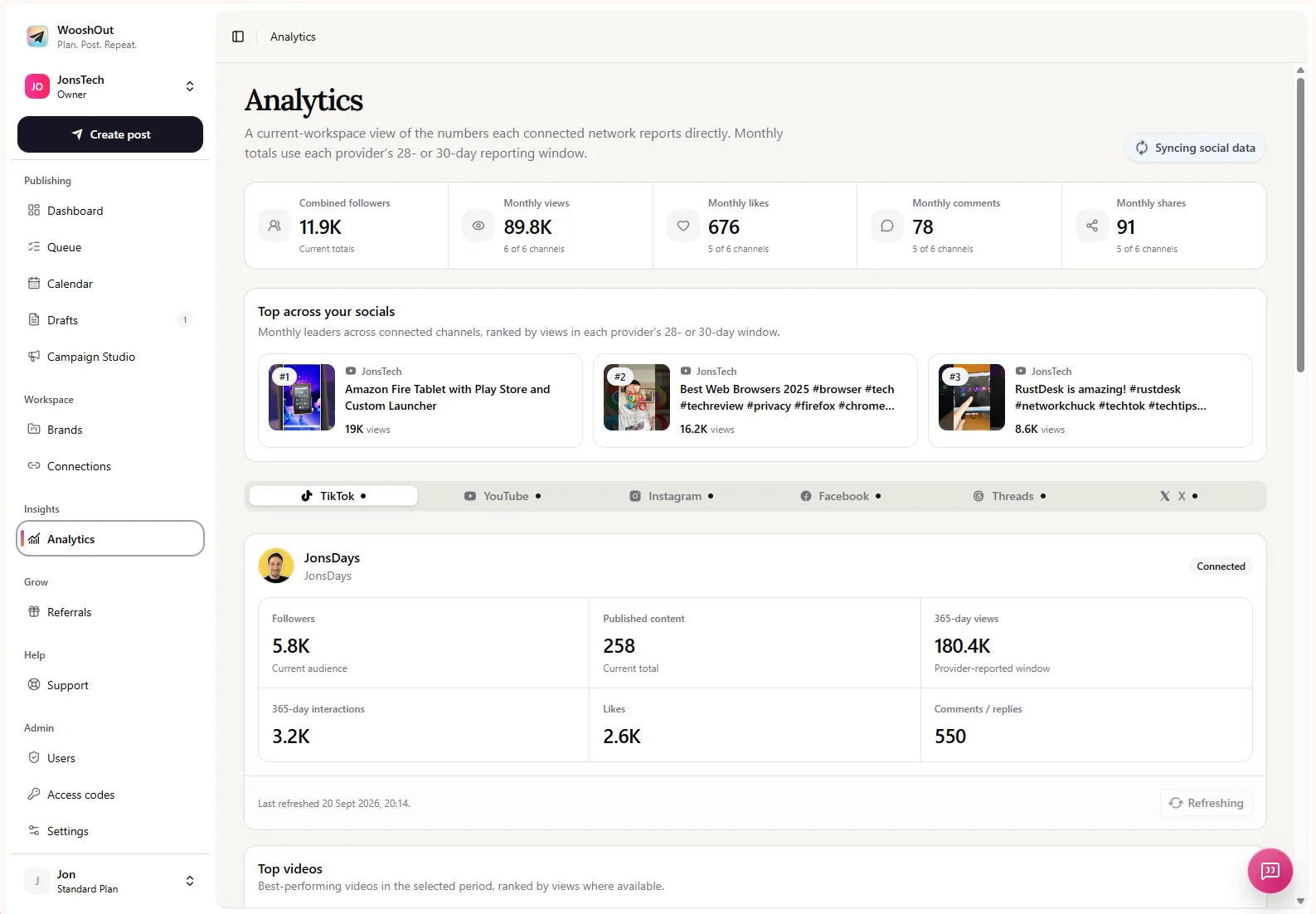
Do not change your entire schedule because one post performed unusually well or poorly. Look for patterns across comparable posts and ask what else may explain them: the topic, format, audience, timing or how clearly the post expressed its point. Analytics can help you ask better questions; they cannot establish that posting more often will cause growth or engagement.
Adjust the schedule when the work says it is time
If you are consistently publishing useful posts and have capacity for more, test a modest increase and review it over time. If drafts pile up, quality slips, or the schedule competes with more important work, reduce the pace. You might also keep a regular baseline and leave room for launches, customer questions or timely updates instead of committing to the same number every week.
The best posting frequency for a SaaS company is the one its team can maintain while giving each post a reason to exist. Start with a manageable plan, make it visible in a calendar or queue, and use provider-reported results as context rather than a promise of what comes next. For a closer look at how the composer, scheduling checks and publishing status fit together, see WooshOut’s publishing workflow.